
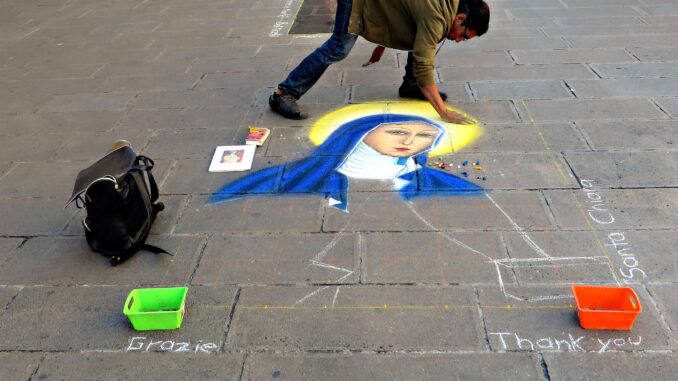
Yesterday, the 11th of August, was the feast of St Clare of Assisi. She was born around 1194 into a life of wealth and privilege. After hearing Francis of Assisi preach, she is said to have slipped out of her family home at night and met Francis and his brothers by torchlight at the Porziuncola, a small chapel outside of Assisi. There, she received the religious habit and had her hair cut short, marking the end of her old life. Despite her family’s resistance, she never wavered.
She founded what became the Order of St Clare, known as the Poor Clares, and campaigned for the right to own nothing, at a time when religious communities normally relied on property for their material security. For Clare, poverty was not simply a spiritual discipline; it was a radical way of following Christ, relying on God’s providence rather than wealth or property, and identifying with those who had neither.
She is also remembered for her courage. When her convent at San Damiano was under threat, Clare reportedly confronted the attackers with the Blessed Sacrament, and they retreated. She is venerated as the patron saint of eyesight and, more surprisingly, of television. Tradition holds that during her final illness, unable to attend Mass, she saw and heard an image of the celebration miraculously projected onto the wall of her room.
Clare died in 1253 and was canonised just two years later, a sign of how deeply her influence had already shaped the people around her. Just two days before her death, Pope Innocent IV approved her Rule, formally recognising the Privilegium Paupertatis — Privilege of Poverty she had spent years working to establish.
What I find most striking about Clare’s life is the resilience and determination with which she lived her faith. She spent almost her whole adult life quietly focused on a way of living the Gospel that was challenging for the institutions of her time to accommodate. Yet through her steadfastness, she had a profound influence on those around her and helped to change perspectives for the common good.